
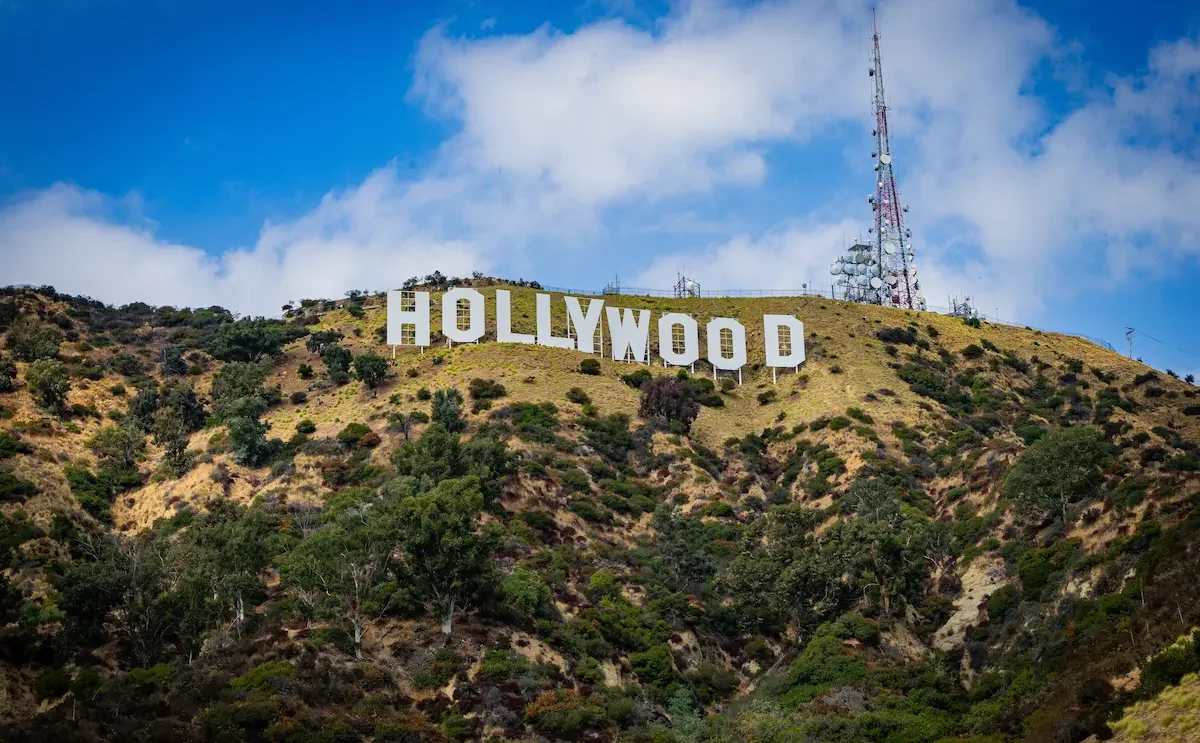
Most of the parks on the lamountains.com map have been Hollywood backlots at some point. The reason is mostly practical. The Santa Monica Mountains and the Simi Hills sit forty minutes from the studios, hold an unusual variety of geology in a tight area, get good year-round light, and were cheap to lease during the Western era. From the early 1910s onward, the studios used them constantly.
Walking them now means walking through frames you have seen, often without realizing it. These are six parks where the film and TV history is dense, the geology is photogenic, and the trail is open in 2026. They cover roughly a century, from a 1923 Buster Keaton short to HBO’s Westworld.
Garden of the Gods, Chatsworth (1912 onward)
The 23-acre Garden of the Gods is the surviving slice of the old Iverson Movie Ranch. More than 2,000 films and TV episodes were shot there between 1912 and the late 1960s. The sandstone formations got their name from a producer who told the Iverson family “who needs to go all the way to Colorado, we have our own Garden of the Gods here,” and the family took the comment literally.
The headline credits: Buster Keaton’s Three Ages (1923), John Ford’s Stagecoach (1939, with John Wayne), and the 40-second opening sequence of The Lone Ranger television series, shot near the Nyoka Cliff with Silver rearing to the William Tell Overture. Gene Autry, Roy Rogers, Hopalong Cassidy and most of the silver-age Western actors rode through these rocks at some point. The site was acquired by the Santa Monica Mountains Conservancy in 1987 and is now an easy 3.1-mile loop trail.
Corriganville Park, Simi Valley (1937 to 1965)
Corriganville Park was Ray “Crash” Corrigan’s working movie ranch from 1937 to the mid-1960s. Corrigan was a B-Western actor who bought the land specifically to lease it as a filming location, and at its peak it was the busiest movie ranch in Hollywood after Iverson.
The 1.7-mile loop trail today passes the foundations of the Western town set, the stagecoach trail, the lake used for the Wagon Train ambush sequences, and the few standing structures that survived two fires in the late 1960s. The full list of credits is long: The Lone Ranger, Rin Tin Tin, Bonanza, the Republic serial Adventures of Captain Marvel, the original The African Queen jungle scenes. Bring a kid who likes cowboys.
Paramount Ranch, Agoura (1927 to today)
Paramount Studios bought 2,700 acres in the Santa Monica Mountains in 1927 to use as a permanent outdoor lot. Paramount Ranch was the result. The Western Town set was built in the 1950s and rebuilt and modified through the decades. Hundreds of Westerns and TV episodes were shot there. The two most-watched runs were the CBS series Dr. Quinn, Medicine Woman (1993 to 1998), which used the town as its main exterior for five seasons, and HBO’s Westworld (2016 onward), which used the same set as Sweetwater.
The Western Town burned to the ground in the November 2018 Woolsey Fire. Reconstruction of four buildings on the original Paramount Studios footprints began in 2023 under the NPS-led Paramount Project. The 2.4-mile loop trail is fully open. What is on the ground in 2026 is less than what was there pre-Woolsey, but the geology and the trail traces are the same as what Westworld’s bandits ran across.
Malibu Creek State Park, Calabasas (1946 to today)
Malibu Creek State Park was 20th Century Fox’s Century Ranch from 1946 to 1974, when the studio sold the land to California State Parks. In those 28 years the property doubled for the South Pacific of the Disney Swiss Family Robinson (1960), several outdoor sequences of Planet of the Apes (1968), and most famously the Korean countryside of M*A*S*H, the CBS series that ran from 1972 to 1983.
The M*A*S*H site sits at the end of a 2.5-mile trail from the main parking lot. The helicopter pad is gone but the unit signpost and the surviving Jeep have been reinstalled, along with the footbridge that was rebuilt in April 2026 after the Palisades Fire took it out. Rock Pool, the swimming hole half a mile in, shows up in several films from the Fox era. Day-use parking is $12.
Will Rogers State Historic Park, Pacific Palisades (1922 to today)
The other parks on this list were studio rentals. Will Rogers State Historic Park was Will Rogers’s home. Rogers built the 31-room ranch house and the polo field in the 1920s and lived there until his death in a 1935 plane crash. He entertained Hollywood there: the polo field hosted his stunt friends and the photography sessions that fed Will Rogers’s own movie-star image during his Fox period. After his death his widow Betty deeded the ranch to California State Parks in 1944 as a living memorial.
The ranch house burned to the ground in the January 2025 Palisades Fire. The polo field, the stables and the 2.2-mile Inspiration Point Loop trail are all back open as of November 2025. The view from Inspiration Point is the same view Rogers walked his horses to at sunset. The chimney of the ranch house is the only piece of the original structure that survived the fire.
King Gillette Ranch, Calabasas (1926 to today)
King Gillette Ranch belonged to King Camp Gillette, the disposable-razor inventor, from 1926. The Wallace Neff Spanish-Mediterranean mansion at the center of the property was designed for him in 1929. From the 1930s into the 1950s the ranch was owned by MGM director Clarence Brown, who hosted most of MGM’s stars there. Later it was a seminary, then briefly a Church Universal and Triumphant compound, then Soka University.
The NPS, MRCA, California State Parks and SMM Conservancy bought the property together and opened it to the public in 2007. Since then the Neff mansion and the grounds have shown up in Pee-Wee’s Big Adventure (1985), HBO’s True Blood, American Horror Story: Roanoke, the MTV reboot of Teen Wolf, six seasons of The Biggest Loser, and Adam Sandler’s Sandy Wexler. The 1.6-mile Inspiration Loop trail is open year-round, and the visitor center inside the old mansion is shared with Malibu Creek.
Why these specific spots
The studios picked these parks for overlapping practical reasons. The microclimate stays dry enough to shoot roughly 300 days a year. The geology compresses high desert, oak woodland, sandstone outcrops, soft-bottom riparian channels, beach bluffs and grassland into a small area. The marine layer burns off most mornings by 10 a.m., the late-afternoon ridge light is reliable, and the drive from Hollywood Boulevard was a manageable forty minutes by the 1930s and is twenty-five by modern freeway. By the time the studios mostly stopped using outdoor lots at scale in the 1960s, the locations were so embedded in the studio visual library that newer productions kept coming back. Westworld, American Horror Story, and Teen Wolf all chose them on purpose.
If you only go to one, go to Paramount Ranch on a clear weekday morning. The reconstruction is real, the trail crosses the same ridges the Westerns used, and you can see what 99 years of Hollywood looking at the same hills looks like on the ground.

